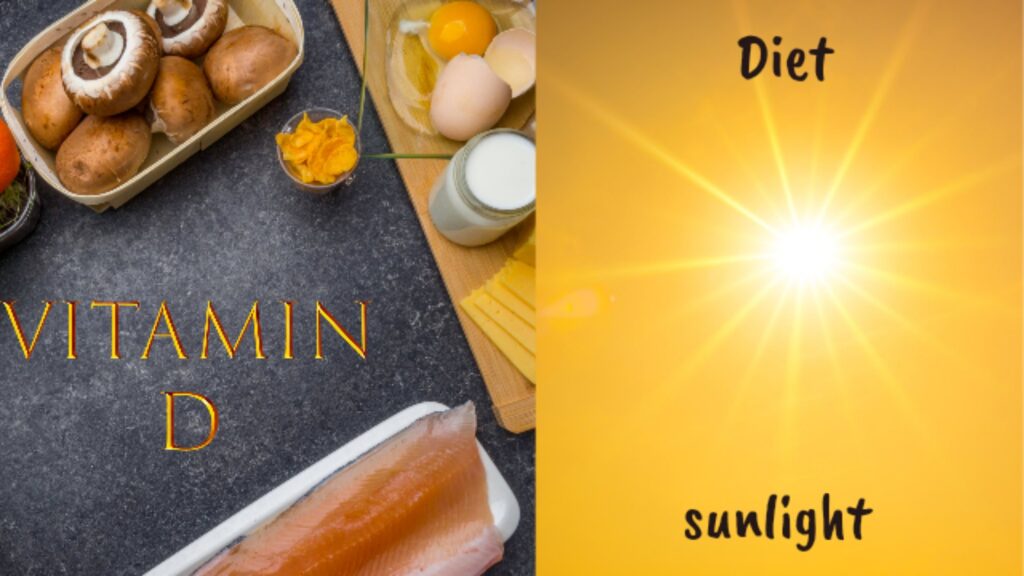
Vitamin D plays a crucial role in calcium homeostasis, immunity, cancer prevention, lung health, sleep, mental health, control of diabetes and pain prevention. Let’s see how to get it adequately from our diet and through sunlight exposure.
Read this link to know in detail about the role of vitamin D in our well-being!
How much Vitamin D do we require?
| 0-12 months | 10 mcg | 400 IU |
| 1 – 70 years | 15 mcg | 600 IU |
| >70 years | 20 mcg | 800 IU |
Diet
We get Vitamin D from
- Animal sources – Cholecalciferol – Vitamin D3
- Plant source (Mushrooms) – Ergocalciferol– Vitamin D2
Sunlight
When ultraviolet B rays from the sun fall on our skin, the compound 7 dehydro cholesterol in the skin gets converted to pre vitamin D3.
The previtamin D3 enters the blood circulation , reaches the liver to become Calcidiol. This again leaves the liver, enters the kidneys to become calcitriol, the metabolically active hormone vitamin D3.
Dietary sources of vitamin D
Vitamin D is a fat soluble vitamin. Major dietary source of vitamin D is animal and animal products, and mushroom. Negligible amount of vitamin D is present in vegan sources.
Egg
Vitamin D is present only in the yolk of an egg. Yolk of one large egg contains upto 40 IU . Whereas, RDA for an adult is 600 IU per day. You may have to eat around 15 yolk to achieve the target!

Milk
1 cup of whole milk (3.25 – 4.50 % of fat) may contain upto 120 IU of Vitamin D. Skimmed milk has negligible or no vitamin D at all.

Cod liver oil
It is the oil obtained from the liver of Cod fish. It is a good source of vitamin D. In addition to this, it also contains Omega 3 fatty acids and vitamin A. 1 teaspoon of cod liver oil contains 400 – 450 IU of vitamin D.

Mushroom
Mushrooms are the only known non – animal vitamin D rich food.When the sun’s rays fall on mushrooms, the compound ergosterol, present in their cell walls is converted to Vitamin D2 called ergocalciferol.
Wild mushrooms contain good amount of vitamin D2. Some wild mushrooms harvested in summer contain upto 1200 IU per 100 grams.This is due to exposure to sunlight in their natural environment.
On the other hand, commonly marketed button mushrooms, oyster mushrooms and shitake mushrooms have only a moderate amount of Vitamin D (40 IU /100gram)
This is because fresh mushrooms available in the market are usually grown in darkness and are exposed to light only during harvest.

Exposing mushrooms deliberately to midday sunlight, (when UV B rays are present) for about 15 – 120 minutes, considerably increases D2 content upto 400 IU per 100 grams (fresh weight).
Not only that, slicing the mushrooms to increase the surface area before sun drying for 60 minutes , increases the vitamin content substantially upto 1300 IU /100 g.
Fish
Fatty sea fish, in particular, wild salmon has high content of upto 1200 IU per 100 gram. But, salmon fish grown in farm has less than 25 % vit D content of wild salmon. Other fish such as cod, sardine, mackerel are moderate to good source of vit D ( 300 IU /100g )

Fortified food
Many western countries fortify food items like milk, yogurt, margarine, breakfast cereals and orange juice with vit D to compensate for the insufficient dietary intake.
Skin as a source of vitamin D
Skin is the major source of vit D because it can produce it in large amounts when compared to any dietary source.
Sunlight
Skin is the largest organ of our body designated to produce Vit D on exposure to sunlight.
Sun’s rays contain
- ultraviolet rays
- Visible light
- Infrared rays
Ultraviolet rays
Ultraviolet rays have lower wavelength than visible light. They are high energy photons. There are three types of ultraviolet rays.
| UV A | 315 – 400 nm | |
| UV B | 280 – 315 nm | |
| UV C | 280 – 100 nm |
UV C is completely absorbed by the ozone layer and does not reach the earth at all. 0nly ultraviolet A and B rays reach the earth surface. Out of the two, ultraviolet B rays have shorter wavelength (290 – 320 nm) and only these photons are responsible for converting 7 – dehydro cholesterol in the skin to pre vitamin D3.
Reasons for Vitamin D deficiency
Obesity
Since Vit D is a fat soluble vitamin, in obese people, it is stored and gets well organized in the fat tissue. As a result, little or no vitamin D is available in the circulation.
Sun avoidance
Many of us in general have sun avoidance behavior. We avoid going out in the sun citing many reasons like heat, sweat, pollution, skin care and migraine.
Though all these are valid points to a certain extent, it can lead to many negative health outcomes in the long run.
Sun screen
Fear of skin cancer and photo ageing is the reason for extensive use of sunscreen lotions. Sunscreens with SPF 30 absorbs almost 98% of the ultraviolet rays.
Skin colour / ethnicity
People living in the tropics are constantly exposed to sunlight and their dark skin colour is due to melanin pigmentation. It is a natural sunscreen that protects our skin by absorbing wide spectrum of radiation.
It effectively absorbs ultraviolet B radiation too. Hence, Asians and Africans need 5 to 10 times more sun exposure than caucasians for adequate vit D synthesis.
Human beings evolved around equator. Their migration towards north and south pole, where sunlight is limited, resulted in natural reduction of melanin pigmentation. This reduction permits more ultraviolet B rays to enter the epidermal cells.This is how efficiently our body evolves according to functional requirements!!!
Time of exposure
99% of UV B rays are absorbed by the ozone layer before it reaches the earth. The remaining 1% ultraviolet B rays reach the earth’s surface only when the sun is directly overhead or when the solar zenith angle is zero or lesser. This occurs from 10 00 am – to 3 00 pm. (between 1100 am and 2 00 pm in particular) It is important to be outdoors in the sun during this time for sometime every day.

In the mornings and evenings, due to more oblique zenith angle, the path taken by ultraviolet B rays is longer and hence very few UV B photons reach the earth. So, exposing our skin to morning and evening sun rays may be beneficial in other ways, but you may not produce enough Vit D.
Sunrays stimulate skin cells to produce beta endorphin ( a feel good hormone) and nitric oxide ( improves blood flow)
Other beneficial effects of sunlight
Geographic location
Latitude
In countries above and below 33 degree latitude, due to more oblique Zenith angle , people do not get ultraviolet exposure during winter. Far north (eg Northern Canada) and far south (eg southern Argentina) countries do not get UV B rays for six months of the year and hence no vit D synthesis occur.
Altitude
Places in higher altitude ( eg Mt Everest base 5300 metres above sea level ) receive more UV B rays because of shorter path length.
Climate and pollution
Lesser ultraviolet B rays reach the skin during cloudy and rainy days.
Air polluted with nitrous oxide and Sulphur dioxide absorb UV B rays.So less photons are available for skin synthesis.
Age
Above 60 years of age, the skin becomes thin and the skins’s ability to produce vit D decreases drastically. In addition to this, if aged people are confined in homes without exposure to sunlight, the deficiency becomes severe.
Vegan diet
Vegans are at increased risk of developing deficiency due to the fact that they do not eat meat as well as animal products such as eggs, milk, cod liver oil etc
Barriers
Clothes, glass and plastic absorb ultraviolet rays and your skin cannot make vit D even though you feel the heat of the sun through these barriers.
Gastrointestinal disorders
In conditions like inflammatory bowel disease, malabsorption deficiency occurs as adequate absorbtion does not happen in the intestines.
Liver and kidney disorders
Liver disorders and chronic kidney diseases lead to deficiency. This is because both pre Vit D3 formed in the skin and dietary vit D pass through two steps. First in the liver, it is converted to storage form and then in the Kidneys into the active hormone form.
How much sun exposure is required?
This depends on the skin type , UV B index (should be >3) in the particular region and the percentage of exposed body parts.
| Low | < 2 |
| Moderate | 3 – 5 |
| High | 6 – 7 |
| Very high | 8 – 10 |
| Extreme | 11 + |
Skin type
| Type I | Very fair |
| Type II | Fair |
| Type III | Creamy |
| Type IV | Brown |
| Type V | Dark brown |
| Type VI | Black brown |
Minimal erythemal dose is the amount of sunlight required to cause mild redness in the skin.
A fair skinned (skin Type I and II) person in a swimsuit, under mid summer sun can produce upto 15000 – 20000 IU with 1 MED. If this occurs in 5 minutes in a white skin, it may take around 30 – 40 minutes in a dark skin (Type V and VI).

In tropical countries, the UV index is high throughout the year. But, factors like skin colour and modest clothing call for more exposure time.
Sensible sun exposure
It is a proven fact UV A and UV B rays cause premature aging, wrinkles, sunburn, suntan, and skin cancer. At the same time, we require adequate sun exposure for vit D synthesis and other benefits.
General recommendations state that with 18 percent body parts exposed and in one third of MED, our skin can make adequate Vitamin D for a day. MED depends on skin colour and the UV B index.

Knowledge about our skin type, geographical location and uv b index of the day (available from weather reporting apps) is essential for calculating the period of exposure.

Can too much of sun exposure cause vitamin D toxicity?
It does not cause toxicity. Excess previtamin D3 formed is converted to two photo products.
- Lumisterol
- Tachysterol
These compounds are not mere inactive byproducts .They have beneficial effects like regulating skin cell growth, preventing formation of cancer cells in the skin and anti proliferation activity (favorable for psoriasis).
Takeaway
Now that we know the extra roles of vitamin D other than maintaining bone health in our body, it is prudent to maintain adequate levels for our mental and physical well being.
Generally, our diets lack adequate Vitamin D due to the fact that very few food sources contain it. Having that in mind , it is wiser to get adequate vitamin D through sensible sun exposure which has many other proven health benefits other than providing Vitamin D.