
Honey is a highly nutritious natural food. It treats and prevents many diseases. It has been used in the traditional systems of medicine for millenniums. Let’s find out what science has documented about its nutrient content and why honey is a functional food.
What makes honey a functional food?
By definition, a functional food is one which contributes positively to health in addition to providing essential nutrients.
Honey boosts our immune system, energy level and promotes longevity. It has more than 180 micro, macronutrients and bioactive molecules. Other than this, it has many unique physicochemical properties.
Bees take nectar and pollen grain from flowers. While nectar is used to make honey, pollen is used as a protein-energy source.
When the bees process the nectar, they also add certain beneficial substances. This makes the honey nutritionally superior.
The composition of honey varies according to the predominant flowers in the area from which the bees get the nectar.
Water content in honey
Honey is a thick, sticky fluid. Ripe or mature honey contains only 15 to 19% water. Let’s see how the bees concentrate the nectar which has a water content of 70 to 80%.
The foraging bees collect the nectar from flowers and place it in their honey stomach. The nectar is partially digested in the stomach. After the bee returns to the hive it transfers the nectar to the hive bees.
The hive bees work together passing the nectar from one bee to another while continuously digesting and reducing the water content. The honey is then placed in the honeycomb cells. This is still high in water content.
The bees work continuously fluttering their wings to circulate air and evaporate water from the honey. When the water content reduces by nearly 18%, the bees seal the cells with wax. The honey now inside the sealed cells is ripe or mature honey.
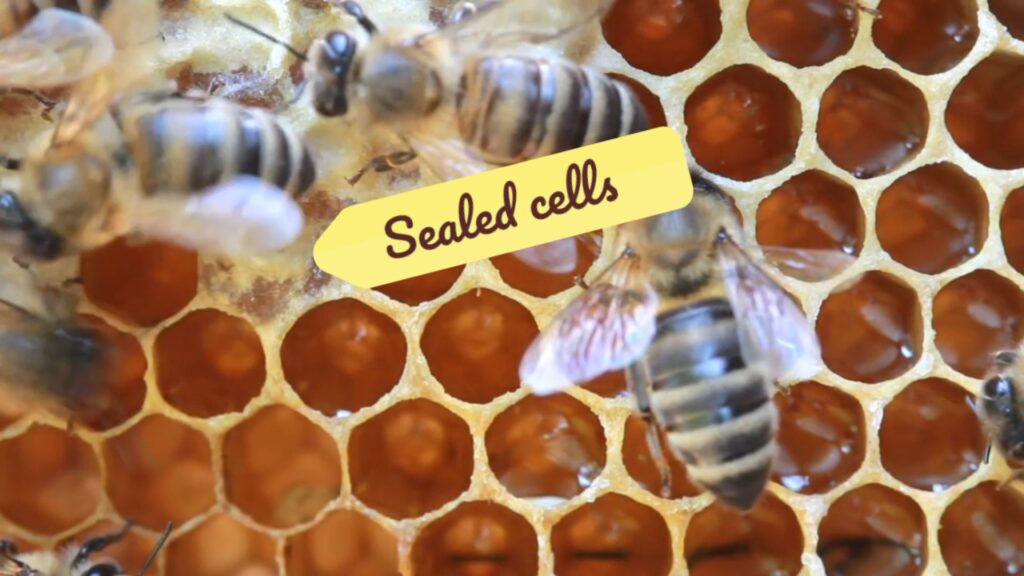
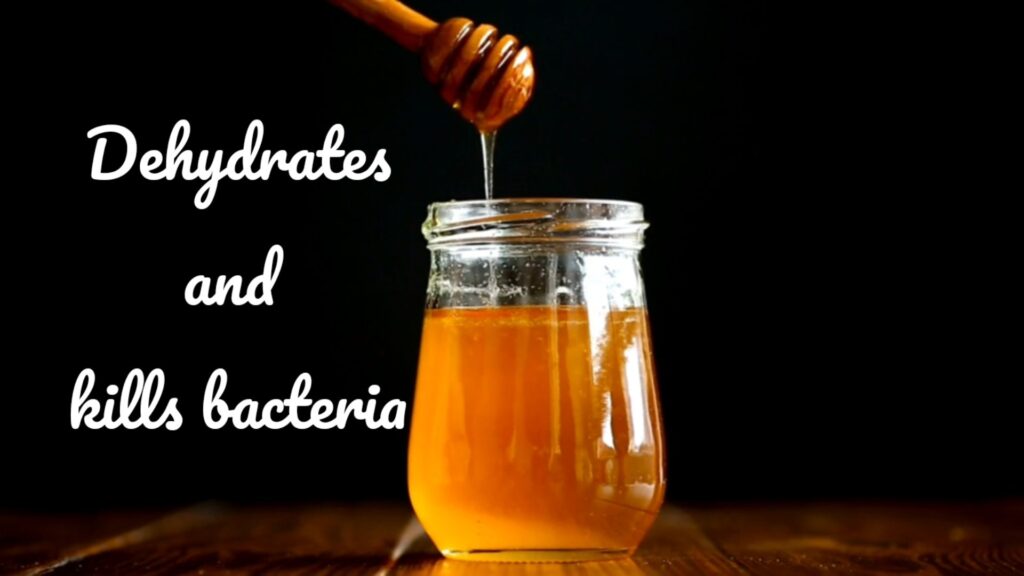
Since it is now a concentrated sugar solution it has high osmolarity. Due to this property, it can suck water from bacteria, dehydrate, and eventually kill them. This is one of the reasons why bacteria cannot multiply in pure honey.
Due to its high sugar saturation, honey is hygroscopic. It means, it can absorb water from the atmosphere just like table salt and table sugar.
Because of this, honey should be stored in airtight containers and should not be left open for long. Otherwise, it can absorb moisture leading to fermentation and spoilage.
Yeast spores are present in raw honey. They become active when the water content increases.
Activated yeast ferment the sugars in honey forming ethyl alcohol and carbon dioxide. Ethyl alcohol breaks down further forming acetic acid. As a result, honey tastes sour.
Sugar content in honey
Nearly 77 to 80% of honey is sugar and there are nearly 25 different kinds of sugar. The main sugars present in honey are the monosaccharides, fructose and glucose. Sucrose, a disaccharide is also is present in a smaller quantity. Up to 10% oligosaccharides may be present depending on the type of honey.
Our digestive system cannot digest the oligosaccharides. So, they become food for the bacteria in the colon. These bacteria ferment the indigestible sugars and multiply. Since honey increases health-promoting gut bacteria, it is a prebiotic food.
Amino acids
All essential and most non essential amino acids are present in honey and proline is the predominant amino acid in honey. Proline also happens to be one of the most abundant amino acids present in collagen.
Enzymes
There are many enzymes like diastase (converts starch to maltose), invertase (converts sucrose to glucose and fructose) and glucose oxidase.
The enzyme glucose oxidase converts glucose to hydrogen peroxide and gluconic acid. Apart from having antibacterial properties, hydrogen peroxide is also a signalling molecule for the wound healing process.
These enzymes are sensitive to heat. High temperatures destroy the enzymes.
Acids in honey
The pH of honey is 3.3 to 4.6. The acidic pH is due to the presence of numerous organic acids. This is why it stings when honey is applied to wounds.
The main acid present in honey is gluconic acid. It forms during the oxidation of glucose. There are numerous acids present in honey-like formic acid, acetic acid, citric acid, lactic acid, malic acid, oxalic acid, succinic acid, etc.
Although organic acids are present only in minute quantities (<0.5%), they contribute quite well to the antibacterial and antioxidant properties of honey.
Polyphenols
There are several flavonoids and phenolic acids present in honey which are potent antioxidants that protect us from free radical damage. These are the main compounds that make honey a functional food.
Honey contains phenolic compounds quercetin, galangin, kaempferol, luteolin, phenolic acid, gallic acid, cinnamic acid, etc. They are powerful antioxidants, anti-inflammatory and anti-cancer agents.
Pinocembrin is a flavonoid unique to honey and a few plant sources like ginger and marjoram. It modulates many cellular functions and can even cross the blood-brain barrier.
It is a potent anti inflammatory and studies have proven the benefits of pinocembrin in preventing cardiovascular disease and brain degeneration.
Heat destroys many of these flavonoids. So, it is not a good idea to add honey to boiling water or to cook honey.
Vitamins and minerals
Although present in very minute quantities, honey also contains vitamins like riboflavin, niacin,folic acid, pantothenic acid and vitamin C.
Minerals like calcium iron, zinc, potassium, chromium, manganese and selenium are also present.
Discussion
Honey should not be stored in places receiving direct sunlight and fluctuating temperatures. It should be stored in a cool dark place.
Also, it is best to consume it as fresh as possible and not store it for long. Although honey may not spoil when stored under proper conditions, it will lose many of its unique functional qualities if stored for a long time.