
For millenniums the human life has revolved around the sun and the moon .Our fore fathers were hunter gatherers and were exposed to the whole spectrum of sunlight on a regular, day to day basis. But, now we are living in an era of sunscreen, skin cancer and photo damage.
Have you ever wondered?A gentle flower faces the sun straight while we humans hide from the sun! Are the sun rays harmful ? Are we designed to spend our life indoors? Lets explore!
In 1903, Niels Finsen received Nobel Prize for his work proving ultraviolet B rays from sunlight is beneficial for patients with lupus vulgaris (TB of the skin).
Vitamin D and the fact it is synthesized when UV B rays fall on the skin was discovered many years later. And exposing tuberculosis patients to sunlight for receiving Vit D was a treatment protocol for many years until the discovery of antituberculous therapy using antibiotics.
Studies suggest the people who grow up without much sun exposure and those who are always indoors are at a higher risk of developing colorectal, ovarian, prostate, breast cancer and non-Hodgkin lymphoma.
What does the sunlight contain?
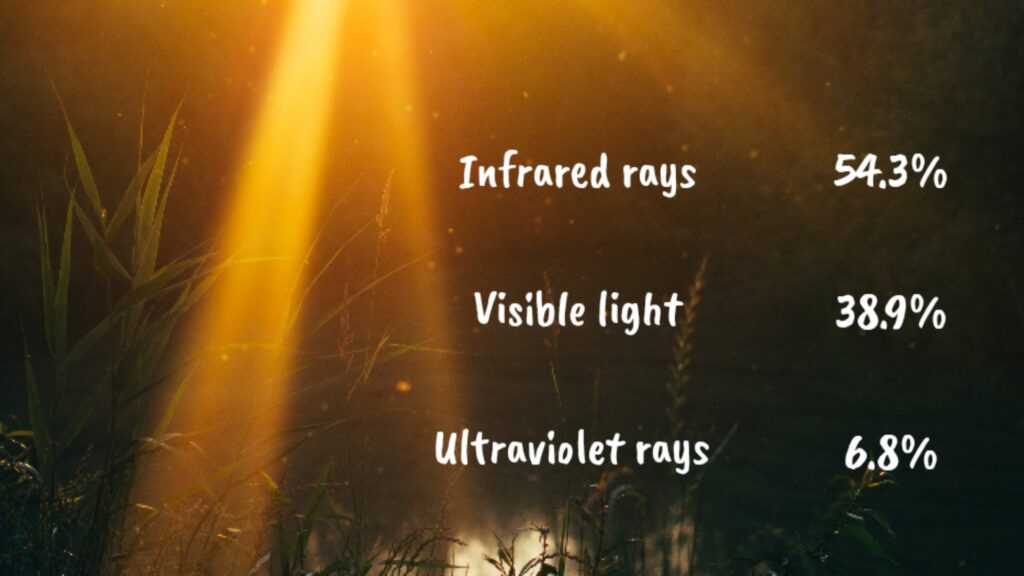
Visible light
This is the spectrum which we see and to which our retina responds.
Getting exposed to bright sunlight first thing in the morning suppresses melatonin produced by the pineal gland and wakes you up completely.
How does sunlight improve our sleep?
Remaining in the sunlight for 30 minutes to 1 hour in the morning not only stops melatonin, but also starts serotonin synthesis in the brain. This sets the rhythm for day time activities.
The brightness of sunshine cannot be compared to any amount of indoor lighting. It is important to go outdoors periodically to take in the natural light. 10 to 15 minutes in the sun without sunglasses can work wonders. When exposed to bright sunlight during day time, melatonin production occurs sooner in the night and you fall asleep faster.
As you approach bedtime, progressively decreasing the intensity of light starting from the evening and being in complete dark (an eye mask can be of help) during bedtime initiates and maintains melatonin secretion throughout the night. This can drastically improve your sleep quality.
Melatonin is a key hormone that counters inflammation, infection, insomnia, premenstrual syndrome and cancer. It also suppresses ultraviolet-induced skin damage. So, a good night's sleep in total darkness is essential for our system to produce sufficient melatonin.
Can sunlight help you to become a morning person?
If you are intending to become an early morning riser, exposure to sunlight first thing in the morning and periodically during the day even for a few days can make you sleepy early in the night.
Seratonin produced in our body in response to sunlight is the precursor of melatonin produced during the night. It may seem a difficult task requiring quite an effort in the beginning. But, once the neuroendocrine rhythm is established, it becomes automatic. The night owl transforms into an early morning bird within few weeks.
Rising and going to bed along with the sun regulates your day-night cycle. This is very important for maintaining neuroendocrine balance in our bodies. Long-term disruption of the circadian rhythm can result in DNA mutation and subsequently cancer.
Immunity
Blue light present in sun rays increases the production of hydrogen peroxide within the T cells which makes them move. Because of this, the T cells can get to the site of infection faster.
Jaundice
Exposing a newborn baby with jaundice to natural daylight under a shade (to prevent heat) is an age-old practice. The blue, green and white spectrum of visible light is effective for reducing bilirubin in a jaundiced infant. Sunlight breaks down bilirubin. A study conducted in 2001, has confirmed that sunlight is 6.5 times more effective than phototherapy units used in hospitals.
Ultraviolet rays
Ultraviolet rays have wavelengths longer than visible light and they are ionizing. It means they can knock off an electron from the molecules they come across and make these molecules unstable. This is the mechanism by which ultraviolet causes damage to our cells.
If you have heard only about the negative aspects of ultraviolet rays like they cause skin cancer, ageing and wrinkling etc, you ought to know about the positive aspects of ultraviolet rays as well!
Two types of ultraviolet rays reach our Earth’s surface: ultraviolet A (95%)and ultraviolet B (5%) rays. The keratinocytes and melanocytes of the skin are sensitive to ultraviolet radiation and have inbuilt UV sensors, a sensory system that can recognise and respond to ultraviolet rays.
UVA rays have longer wavelengths when compared to UV B rays and hence penetrate deeper into the skin. The melanin pigment, RNA, DNA and many protein molecules present in the cells of the skin efficiently absorb UV B photons.
Nitric oxide
When ultraviolet A rays fall on the skin, nitric oxide is released into the blood. Nitric oxide dilates the blood vessels and decreases vascular resistance consequently decreasing the blood pressure. It is also involved in antimicrobial activity and wound healing.
Neuro endocrine balance
UV B rays potentially control the neuroendocrine system of our body and help in maintaining homeostasis.
These rays are capable of regulating the hypothalamic-pituitary axis and can play a role in controlling the stress response in our body.
Vitamin D
When exposed to the midday sun, UV B rays convert 7 dehydrocholesterol present in our skin to vitamin D. Vitamin D, a steroid hormone, plays a major role in the functioning of the skeletal and neuromuscular system, helps in controlling inflammation, prevents cancer, diabetes, hypertension, pain and depression. It also plays a role in promoting sleep. Vitamin D plays a significant role in preventing frequent respiratory tract infections. It prevents cytokines storm (a cause of severe lung damage and death) in case of covid-19 infection. These are few roles Vitamin D plays in maintaining health.
Anti depressant effect
The skin cells like keratinocytes, melanocytes, and fibroblasts produce endorphins when they are exposed to UV B rays.
Endorphins (endogenous morphine) are so-called because they produce a morphine-like effect in our body.
Ultraviolet B rays are more efficient than UV A rays in increasing beta-endorphin production not only in the skin but also in the brain. These rays activate the hypothalamic paraventricular nucleus in the brain and have a deep impact on brain health.
They also regulate mood disorders, addiction, and obesity. It boosts metabolism and controls appetite.
More importantly, endorphins act like an analgesic and also promote a sense of well-being. Our cells express opioid receptors for endorphins. Endorphins bind to these receptors and inhibit the release of compounds like substance P which transmit pain.
It also blocks the release of GABA, a neurotransmitter, which results in increased production of dopamine in the central nervous system. Dopamine increases the feeling of pleasure. This should explain why we get a sense of well-being when the sun rays touch our skin while we step out.
Immunomodulation
Having a good immune system helps you fight against diseases. At the same time, an overreactive immune system can wreak havoc inside your body. It misinterprets your cells as foreign bodies and starts fighting the cells. This is the basis of autoimmune diseases.
Both UV A and UV B rays upregulate T regulatory cells which suppress the over-reactive immune response. Regular sun exposure can prevent and control autoimmune disease disorders like multiple sclerosis and rheumatoid arthritis.
Skin health
Psoriasis is a skin disease characterized by rapid turnover of skin cells leading to the build up of scales and patches. UV B rays decrease inflammation and reduce the turnover rate of skin cells.
Infrared rays
Infrared rays have a longer wavelength than visible light. They are non-ionizing rays. We perceive infrared rays as heat. These rays are not blocked by the melanin pigments in our skin and hence can penetrate the skin and even reach the internal organs.
| IR A RAYS | 760 – 1400 nm (NEAR INFRARED RAYS) |
| IR B RAYS | 1400 – 3000 nm |
| IR C RAYS | 3000 – 1 mm |
Near-infrared rays ( NIR) offer many beneficial effects on the human body. In the morning and evening, there is relatively lesser ultraviolet rays and more infrared rays in the atmosphere. The temperature is cooler. So, these are ideal times to expose your skin to infrared rays without increasing the skin temperature.
Infrared rays are absorbed by cellular molecules. The absorbed photons stimulate many biological pathways and produce ATP, nitrous oxide, etc. These pathways also produce growth factors and anti-inflammatory chemicals.
Controlled exposure to the sun every day can have myriad health benefits.
Skin health and wound healing
Infrared rays promote wound healing, decrease inflammation and pain. They also improve the density of skin collagen resulting in reduced wrinkles and fine lines.
Brain health
When these rays fall on the scalp, they can penetrate up to 3 cm into the skull and reach the brain. This increases blood flow, enhances neuroprotection and neuroregeneration. This results in improved cognition, spatial learning.
Infrared rays can clear beta-amyloid plaque deposits in the brain which are responsible for Alzheimer’s disease. It also can potentially improve conditions like traumatic brain injury, stroke, depression and anxiety.
Why do we avoid sun ?
Fear of skin damage
Our skin’s natural protective mechanism like the outer dead cell layer stratum corneum reflect and refract the ultraviolet rays to a certain extent.
The remaining ultraviolet radiation which reaches the inner layer induces melanin-producing cells to produce more melanin to absorb the ultraviolet radiation. Melanin is not only a sun protective factor but also an antioxidant that can reduce free radical damage.
It is not the sun’s rays but our rigorous skincare regimen of removing the dead cell layer completely and procedures that reduce melanin pigments that cause more damage.
Moreover, the skin is subjected to more damage in people whose diets are lacking in antioxidants. Human skin contains carotenoids, like α-, γ-, β-carotene, lutein, zeaxanthin, lycopene, etc which protect against free radical damage. So, it is better to consume antioxidants orally and increase the tissue content rather than applying topically as it can be washed away by perspiration and moisture.
Migraine
Both intense heat and light from sunlight can indeed trigger migraines. This can be avoided by wearing sunglasses and covering the head to a certain extent.
Chronic hypohydration can also trigger migraines. Adequate hydration before stepping out is a crucial factor for preventing migraines.
Also, complete avoidance of sun and migraine can form a vicious cycle. Hence, it is important to break the cycle by going out in the sun whenever there is no intense heat and light to precondition oneself.
What time and how much of sunlight?
It has been established that visible and infrared rays are prevalent early in the morning. Infrared rays precondition the skin and prevent damage from UV radiation which can occur later in the day.
Likewise, late afternoon exposure results in tissue repair if any damage had occurred during the day. This preconditioning and tissue repair process is termed photobiomodulation.
Noontime (11:00 p.m. to 2:00 p.m.) is the time during which ultraviolet B rays are prevalent due to the shorter zenith angle of the sun. UV B rays are most crucial for vitamin D synthesis by the skin. The amount of exposure time depends on the skin type and the ultraviolet B index prevalent in the particular region.
(Follow this link to know more about sun exposure time and skin type)
Take away
The benefits of sun rays far outweigh the deleterious effects of sunlight, if safe sun exposure is practised. It is important to get an adequate dose of the entire spectrum of the sun’s rays in the morning, around noon, and evening every day for overall health benefits.
It is easier to prevent diseases by getting adequate and safe sun exposure rather than going for treatments with low-level light therapy, infrared light therapy, and UV B therapy after becoming unwell!